

Someone in Calgary types “find me a plumber” into ChatGPT, and what comes back looks a lot like a Google search result. A map with star ratings, three companies listed with phone numbers, everything a person needs to make a call. Except it’s not Google, and the way those three companies got there has almost nothing to do with the strategy most contractors are running.
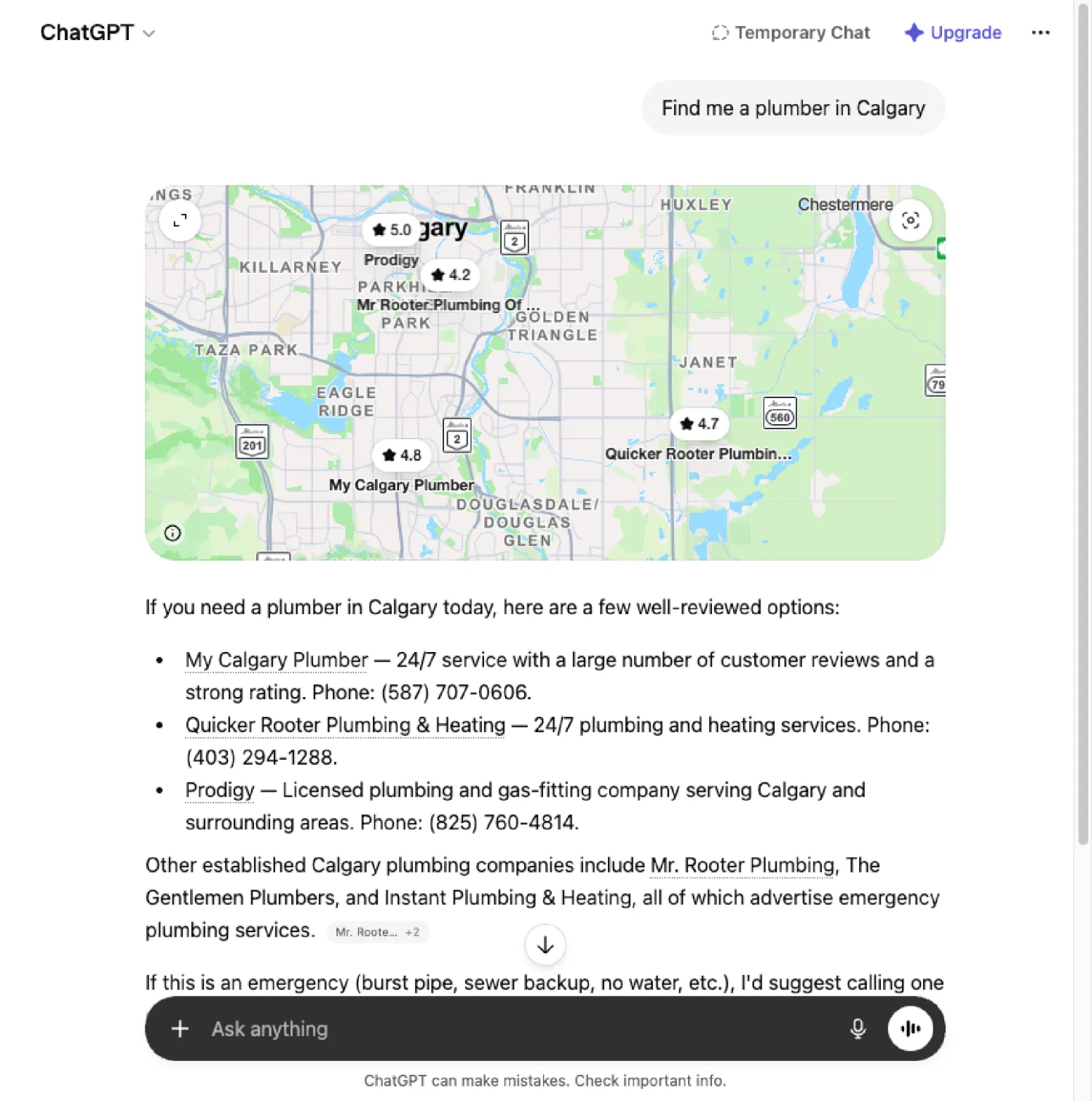
Your company might have 200 Google reviews, a Google Business Profile you update every month, and $4K/month in Google Ads. And most of that barely factored into ChatGPT’s answer, because ChatGPT reads different inputs than the ones your strategy is built around. If that sounds like the kind of shift that only matters “someday,” consider that 15 years ago, a lot of businesses said the same thing about Google itself, right up until the Yellow Pages stopped ringing.
How ChatGPT actually answers a local query
ChatGPT has described its own process roughly like this: it runs a web search, historically through Bing, for whatever the person typed, scans the top 20 to 30 results, including business websites, review aggregators, local blogs, and directories, and then narrows that down to 5 to 8 sources that look promising before selecting 3 to 5 for the final answer. It favours sources that clearly show a star rating, aren’t behind a paywall, and are verifiable. Then it writes a summary in its own words, citing those sources.
That sequence comes from a Search Engine Land investigation where ChatGPT narrated its own steps, not from OpenAI’s official documentation. Language models can’t actually inspect their own retrieval pipeline, so treat that self-description as plausible illustration rather than documentation. OpenAI has never published these numbers. What OpenAI has confirmed is that for Enterprise and Edu workspaces, Bing is currently the sole third-party search provider. Its consumer documentation says only that ChatGPT “sometimes partners with other search providers,” plural and unnamed. Seer Interactive found that 87% of SearchGPT citations matched Bing’s top results in early 2025, and a Search Engine Land study in April 2026 found Bing rankings still predict ChatGPT brand mentions better than Google’s do. Bing-heavy is the best description. Bing-only is not.
What’s also worth knowing is that this is already changing. OpenAI is building its own search index through a crawler called OAI-SearchBot, which tripled its web crawl activity after GPT-5’s launch in August 2025 according to an analysis of over 7 billion server log entries. There’s evidence the company is transitioning away from Bing as its primary index entirely. The mechanics are shifting, but the inputs (your website, your web presence, the things you actually control) remain what the system reads regardless of which index it uses.
What’s mostly missing from the sequence is the thing contractors spend the most on: Google’s ad system and Google’s local ranking factors. ChatGPT doesn’t buy its answers from Google. There is evidence it sometimes pulls from Google’s index (independent tests caught it doing exactly that in 2025, and an AirOps study of 548K retrieved pages found pages ranking #1 in Google were cited 3.5x more often than pages outside the top 20). But your Google Ads and your map-pack position aren’t inputs it reads.
What it reads
BrightLocal ran 800 local business searches through ChatGPT in late 2024 and tracked every source it cited. The breakdown was 58% business websites, 27% third-party mentions like “best of” lists and local guides, and 15% directories. What I mean by that is: when ChatGPT answered a question about a local business, more than half the time it was pulling directly from that business’s own website. Their service pages, their about page, their contact info. The third-party mentions were things like curated “best of” lists, niche blogs, and local guides where someone else had written about the business. And the directories that showed up weren’t the ones most people would expect: Three Best Rated was the top directory source, while Google Maps didn’t appear at all. Wikipedia, notably, made up 39% of all third-party mention sources.
BrightLocal’s October 2025 follow-up, which looked across several AI platforms rather than re-running the original study, found the same pattern: businesses’ own websites were the dominant source everywhere they looked. A larger study backs it up from a different angle. Yext analyzed 6.8 million AI citations across ChatGPT, Gemini, and Perplexity in mid-2025 and found that 86% of citations came from the brand’s own website or its listings (roughly 44% websites, 42% listings). The two studies actually disagree on how much listings matter compared to websites, and that’s worth knowing: the picture is still settling. But both point in the same strategic direction. The overwhelming majority of what AI cites is stuff the business controls. Not ads, not someone else’s algorithm. Your website and your listings.
One caveat on the Yext numbers: Yext sells listings management, so a finding that listings matter as much as websites is conveniently on-brand for them. Same class of caveat we apply to the Stackmatix structured-data figure later, so apply it consistently. Their study also spans three AI platforms, not just ChatGPT, so it can’t cleanly corroborate a ChatGPT-specific percentage.
What it can’t see, and what it can
This is the part that matters if your strategy is built around Google, because the relationship between ChatGPT and Google is more complicated than most people assume.
There’s no confirmed direct integration between ChatGPT and your Google Business Profile. ChatGPT doesn’t log into your GBP dashboard and read what’s there. As of late 2024, OpenAI added a map and local-listings feature to ChatGPT’s local results, which is why you see a map with businesses like the Calgary plumber result. OpenAI hasn’t named where that map layer’s underlying data comes from, but independent analyses keep pointing at Foursquare’s database with Mapbox drawing the map, and BrightLocal’s October 2025 observations landed in the same place. That’s converging evidence, not confirmation, but it’s the best picture available. BrightLocal also observed ChatGPT falling back to Google Business Profile data when Foursquare came up empty, which makes sense: public GBP pages are crawlable web pages like anything else. So be skeptical of anyone who tells you ChatGPT is piping your GBP straight into its answers, because that path isn’t established, but don’t assume it can never see GBP data either.
What that means is: don’t assume ChatGPT is reading and ranking your Google Business Profile the way Google does, because we can’t confirm that it is. When it cites a source in its answer, that citation still overwhelmingly points to your website (58% of the time in BrightLocal’s measurement) rather than to your Google listing. Keep your GBP accurate, it can’t hurt, but here your website is the thing that gets cited.
The other platforms each tell a slightly different story. Bing Places doesn’t get read directly by ChatGPT either, but because ChatGPT’s search results have historically leaned heavily on Bing’s index, your Bing Places listing influences what shows up in those results. A complete Bing Places profile can indirectly shape what ChatGPT surfaces. Yelp is a bigger story now than it was when we first published this post. In BrightLocal’s late 2024 study, Yelp didn’t appear as a directory source at all. That changed on July 23, 2026, when Axios reported a signed licensing deal between Yelp and OpenAI. The terms are now public: OpenAI licensed roughly 330 million Yelp reviews and 8M+ business listings. Yelp branding, star ratings, and back-links appear in ChatGPT’s local answers. The deal is non-exclusive. And the detail that matters most for this audience: Yelp’s Request a Quote flow is planned inside ChatGPT, meaning users could request contractor bids without leaving the chat. That’s not just a citation anymore. That’s a lead-capture surface inside the AI itself. We called the direction correctly in June; the specifics are now confirmed and bigger than we expected.
Facebook was absent from BrightLocal’s directory results, but many businesses keep their Facebook page more current than their website, which makes it a useful secondary source for hours, events, and contact info.
The through-line across all of this is that your website still carries the most weight in what gets cited, but the ecosystem around it matters more than it did even a year ago. GBP, Bing Places, Yelp, Foursquare, and Facebook all feed the system in different ways. The contractors who are most invisible aren’t the ones missing one of these; they’re the ones whose website gives the agent nothing to work with, and who haven’t thought about any of these secondary inputs at all.
What we saw when we tested it
We ran five queries through ChatGPT in June 2026, all for Canadian home service businesses. Five queries on a non-deterministic system illustrate patterns rather than prove rules, but the variation itself turned out to be the most interesting finding.
When we searched “find me a plumber in Calgary,” ChatGPT showed a map with star ratings and listed three companies with phone numbers, with source tags pointing to business websites. That one was straightforward: it found companies with a strong web presence and surfaced them directly.
“Top rated roofing contractor in Ottawa” brought up another map with five companies pinned, and the text referenced BBB Torch Awards, Consumer Choice Awards, and years in business. What was interesting there is that it wasn’t just reading websites. It was pulling credibility signals from third-party mentions and industry awards, which maps directly to that 27% third-party mention layer from the BrightLocal data.
“Best HVAC in Toronto” produced something completely different. No map, no company recommendations at all. Instead, ChatGPT gave general buying advice: check warranties, ask about load calculations, don’t choose based on equipment brand alone. It cited Reddit. If you’re an HVAC company in Toronto, you weren’t competing for a ranking here, because the agent decided not to recommend anyone in the first place.
“Landscaping company near me in Vancouver” listed four companies, each with a source tag linking to their business website, and then it did something we didn’t expect: it asked clarifying questions. What kind of landscaping? Full redesign? Patio? Maintenance? It wanted to narrow the scope before committing to a recommendation. A prompt also appeared asking the user to share their precise location for better results.
“Who should I call for furnace repair in Winnipeg” was perhaps the most revealing. Only two companies were named, and before recommending either of them, ChatGPT gave troubleshooting steps: check the thermostat, check the breaker, check the air filter. It cited Reddit for the advice. Then it asked three clarifying questions. The agent tried to solve the problem before sending a lead to anyone.
One pattern worth connecting: when BrightLocal ran their 800 searches in late 2024, forums didn’t appear as a source at all. Zero Reddit, zero Quora. By the time we ran these five queries in June 2026, Reddit showed up twice. The source mix moves.
Three things this tells you
1. The agent decides whether to recommend anyone at all.
You’re not just competing for position in a list. You’re competing for the list to exist in the first place. In Toronto, ChatGPT decided general advice was more useful than naming specific companies. In Winnipeg, it tried to troubleshoot the problem before recommending a contractor. A business that isn’t visible in these moments doesn’t just lose a ranking; they lose the opportunity entirely, because the agent never surfaced a consideration set. Before, if someone searched “best HVAC in Toronto” on Google, every HVAC company with an ad or a listing had a shot at being seen. Now, the agent might decide the person doesn’t need a company yet.
2. How someone asks changes everything.
“Find me a plumber” got a map and phone numbers. “Best HVAC” got buying advice. “Who should I call for repair” got troubleshooting first. These are the same category of business, but three completely different response types based on how the question was phrased. There’s no single “local search result” to optimize for anymore. The agent reshapes its entire answer based on what it thinks the person actually needs.
3. Your website carries most of the weight.
58% of what ChatGPT sources is your website in BrightLocal’s ChatGPT-specific measurement. Yext’s larger study across ChatGPT, Gemini, and Perplexity found 86% of AI citations come from brand-managed sources, split roughly evenly between websites and listings. The two studies weight things differently, but the strategic takeaway is the same: the vast majority of what these systems cite is stuff you control. What that means in practice is that your site needs to do more than look good. It needs to be readable by a system that’s scanning it for structured information about what your business does, where you are, and what services you offer. Schema markup like LocalBusiness makes that information machine-readable. One vendor analysis reports that around 71% of pages ChatGPT cites include structured data. Treat the figure as directional rather than gospel, since it’s a single source with an interest in the answer. Our read is that structured data helps here, and the correlation supports it, but nobody has isolated it as a cause. Sites with schema tend to be well-maintained sites, and no study has separated those variables. Still, it’s low-cost and right for other reasons. A site with clear service pages, location info, and structured data gives these systems something concrete to parse. The businesses that showed up in our tests all had one thing in common: their websites gave the agent something concrete to work with.
What makes you invisible
If you recognize yourself in a few of these, that’s the diagnostic, and it’s worth being specific about why each one matters.
When your entire local strategy is built around Google (GBP, Google Ads, Google reviews), most of that investment doesn’t transfer to ChatGPT the way you’d expect. Your Google Ads spend is invisible to ChatGPT entirely. Your GBP might help at the margins, but the thing that actually gets cited is your website. What I mean by that is: the money and effort are real, and they still work for Google search, but they give you much less coverage in this second channel than you’d assume.
That doesn’t mean there’s no paid surface in ChatGPT at all. OpenAI launched its own ads in ChatGPT on February 9, 2026 for US users on the Free and Go tiers, and opened self-serve Ads Manager with no minimum spend in May 2026. Early advertisers include Lowe’s and Best Buy, which is squarely home-services-adjacent. These are clearly-labeled sponsored placements, and OpenAI says they run separately from the organic answers. Expansion to Canada has been reported as on the roadmap for 2026, though that’s unconfirmed. The organic answers can’t be bought, but the screen they appear on now has ads next to them.
When your website is thin (one page, a phone number, maybe a stock photo), there’s nothing for the agent to extract. It needs service descriptions, location info, and enough content to understand what you actually do. A single-page site is a blank to a system that’s scanning for structured information.
When your site doesn’t use schema markup to describe your business in a format machines can parse cleanly, you’re relying on the agent to figure out what you do from paragraph text. It can sometimes manage that, but you’re making it harder than it needs to be, and the businesses that make it easy are the ones that get cited.
When nobody’s written about you, whether that’s “best of” lists, local blog mentions, or curated directories, you don’t exist in that 27% third-party mention layer. The Ottawa roofing results pulled from BBB awards and industry recognition. If there’s nothing like that out there for your business, that entire source category is empty for you.
When you’ve never touched Bing Places, you’re missing an indirect lever. ChatGPT doesn’t read Bing Places profiles directly, but its search results have historically leaned heavily on Bing’s index, and your Bing Places listing influences what shows up in those results. Before, Bing felt like an afterthought because almost all search traffic came through Google. Now there’s a second system that leans on Bing’s index (though that’s shifting too, as OpenAI builds its own), and leaving your Bing presence empty means you’re not feeding the pipeline that ChatGPT draws from.
What makes you visible
The fix mirrors the diagnosis, and most of it comes down to things you already control.
Your website needs to do the talking. That means clear service pages, each one describing what you do, where you do it, and for whom, with contact info on every page. Not a brochure, but a source an agent can read and cite. Before, a website mostly needed to look professional and load when someone clicked an ad. Now it also needs to be the kind of page a system can scan and pull structured facts from.
Structured data on your site, specifically LocalBusiness schema markup, makes your name, address, phone, hours, services, and service area machine-readable. One vendor analysis reports that around 71% of pages ChatGPT cites include structured data. Treat the figure as directional rather than gospel, but structured data is one of the clearest levers you have, even if it’s no guarantee of inclusion.
Third-party mentions matter more than most contractors realize. Getting on curated “best of” lists, getting written about by a local blog or industry publication: these feed the 27% of sources that aren’t your own website. Three Best Rated was the #1 directory source in the BrightLocal study, not Yelp, not the Yellow Pages.
Claiming and completing your Bing Places profile is worth the effort, even though ChatGPT doesn’t read it directly. Your Bing Places listing influences Bing’s web results, and those web results are what ChatGPT scans when someone asks a local question. Most of your competitors haven’t touched their Bing presence at all, which means this is a low-effort way to show up in a pipeline they’re ignoring.
Claiming your Foursquare listing is worth doing too. The converging evidence that Foursquare’s database feeds ChatGPT’s map layer means a stale or unclaimed Foursquare profile could be a bigger visibility hole than you’d expect. Since the Foursquare consumer app shut down, many listings are badly outdated. Check yours. This carries the same confidence level as the Bing Places advice: not officially confirmed, but the evidence points the same direction. The Yelp deal may eventually reshuffle which data source powers the map layer, but right now Foursquare keeps showing up in the analyses.
Allowing OAI-SearchBot matters too. OpenAI’s own crawler is what feeds ChatGPT’s search index, and if your robots.txt file blocks it, your content can’t be cited or summarized. At most a bare link and page title might still surface if ChatGPT learned the URL from a third-party source, but the substance of your site stays invisible. OpenAI’s publisher FAQ specifically names allowing this crawler as a requirement to be eligible for citation.
And consistent NAP (name, address, phone) across every site, every directory, every mention. Our read is that inconsistency across listings is one of the simplest ways to get skipped by a system that’s cross-referencing sources. That’s inherited from how local SEO has always worked, and it’s the safest assumption for a system pulling from multiple data providers, even if nobody has tested the mechanism directly in LLMs.
This isn’t about replacing Google
Your Google strategy still matters for Google search, and a little of it may carry over to ChatGPT through the map feature, though that path isn’t something we can confirm. But the weight distribution is different. In Google search, your GBP and your ads carry most of the load. In ChatGPT, your website carries most of the load, and everything else (GBP, Bing Places, directories, third-party mentions) plays a supporting role. Before, being well-positioned on Google was effectively the whole game for local search. Now there’s a parallel system that reads overlapping but different inputs, weights them differently, and makes its own decisions about whether to recommend you at all.
The plumber in Calgary who got recommended had a website that gave ChatGPT something concrete to cite. The HVAC company in Toronto that didn’t get recommended? We don’t know who they are, and neither does the person who asked. That gap between being visible and being invisible to this system is going to matter more over time, not less, in the same way that the gap between businesses who figured out Google early and those who didn’t ended up compounding for years.
Sources
Studies and data
- BrightLocal: Uncovering ChatGPT Search Sources (Dec 2024, 800 manual searches, 58/27/15 split)
- BrightLocal: AI Search Makes Listings More Important (Oct 2025 follow-up, observational multi-LLM confirmation)
- Yext: 86% of AI Citations from Brand-Managed Sources (Oct 2025, 6.8M citations across ChatGPT/Gemini/Perplexity)
- Stackmatix: Structured Data AI Search 2026 (~71% structured-data stat; single vendor, treat as directional)
- Botify: OpenAI Tripled Its Web Crawl (7B+ log files, Nov 2024 through Mar 2026)
- Seer Interactive: 87% of SearchGPT Citations Match Bing (Feb 2025)
- Semrush: ChatGPT Definitely Uses Google (Aug 2025, reproducible experiment)
- AirOps: Influence of Retrieval Fan-out and Google SERPs in ChatGPT (Mar 2026, 548K pages across 15K prompts)
- Search Engine Land: Bing Ranking Predicts ChatGPT Visibility (Apr 2026)
OpenAI documentation
- OpenAI: Publishers & Developers FAQ (OAI-SearchBot guidance, ads/answers separation)
- OpenAI: ChatGPT Search (consumer doc, “other search providers”)
- OpenAI: ChatGPT Search for Enterprise (Bing named, enterprise/edu scope)
Analysis and reporting
- Axios: Yelp Reviews Coming to ChatGPT (Jul 2026, confirmed deal terms)
- Search Engine Land: How does ChatGPT conduct local searches? (May 2025)
- Local Falcon: ChatGPT Local Search Data Sources
- Flowemedia: ChatGPT’s Secret Source: Google Maps (the late-2024 map/local-listings feature; data provider unconfirmed)
- Esasson: Why GBP Now Matters for ChatGPT
- gmbapi: How to Make LLMs Recommend Your Business (Foursquare/Mapbox analysis; SEO-vendor source)
- LaunchCodex: ChatGPT Ads Breakdown (timeline, tiers, self-serve details)
First-party
- 5 ChatGPT queries, Canadian home services, June 2026